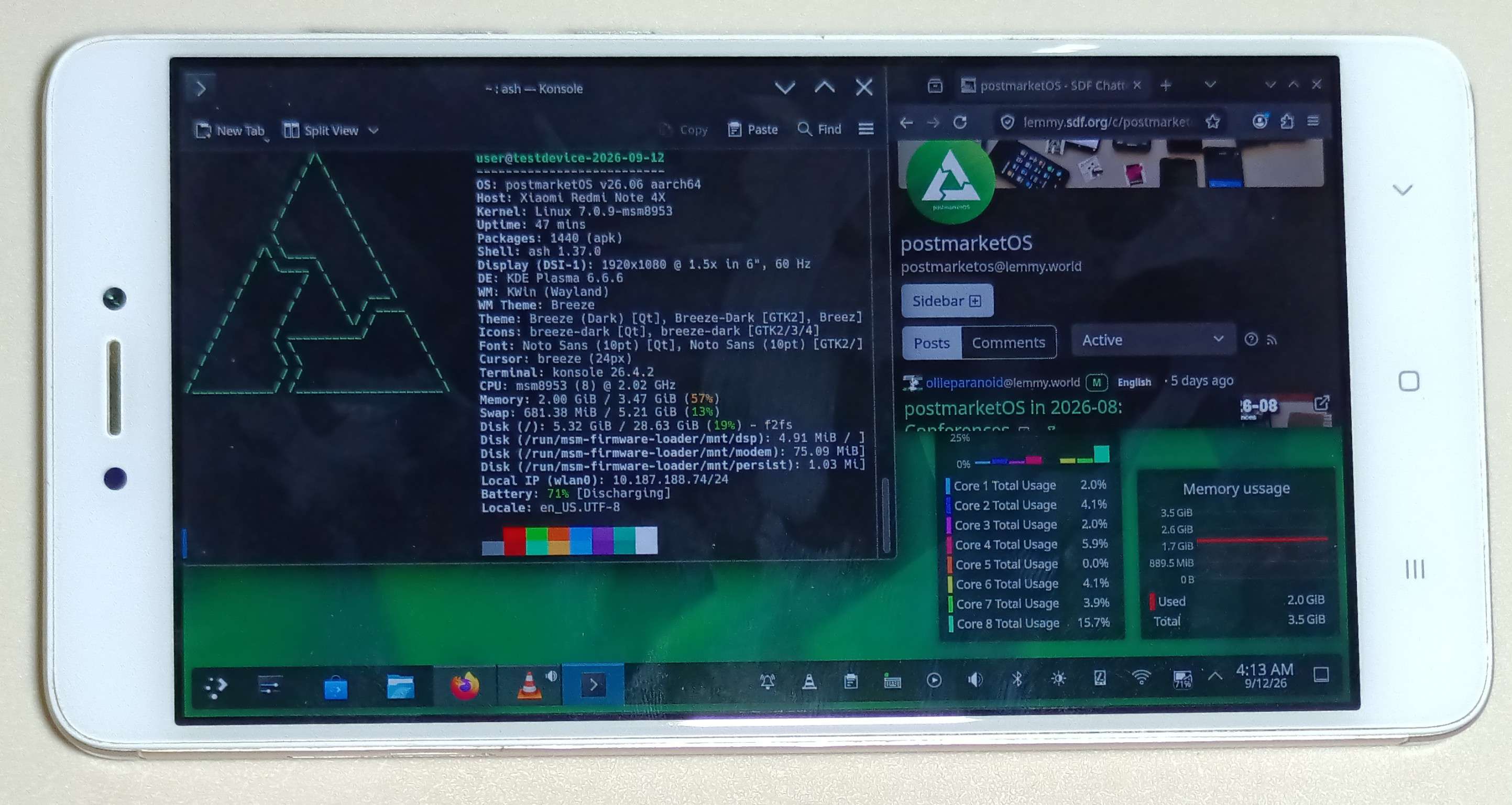
Hardest part?
Unlocking the bootloader. Because it’s Xiaomi. I have screenshots from the whole process, but that’s more of a thing for “mildly infuriating” community.
Fun fact: Xiaomi doesn’t even allow installing APKs via ADB without Mi account…
Why is it running plasma-desktop?
It’s the first UI I tried. I’ve used it with a touchscreen before, and it worked well.
I’ve also tried installing both plasma-mobile and plasma-desktop, but the configurations seem to clash.
Also, when I use Android I always increase DP in developer settings to >600 which switches some UI elements to tablet mode. I prefer more things on the screen.
plasma-mobile vs plasma-desktop
Apples and oranges, yes, but I’ll compare them. I am allergic to apples, but not oranges. Wait, that’s not what I was talking about…
Nice things in plasma-desktop
- Sleep works (dmesg reports
s2idle). - More powerful UI (proper desktop).
Nice things in plasma-mobile
- Extra buttons in Konsole (tab, arrows, ctrl).
- Screen can be locked and turned off.
- Existing buttons on phone are automatically mapped to navigation in Plasma.
Bad things about plasma-desktop
- Even if I set power button to “Turn of screen”, it immediately turns back on.
- Awful CLI experience without needed buttons.
- Pressing back and home buttons causes awful noise on headphone output.
Bad things about plasma-mobile
- Sleep isn’t available as power option.
systemctl suspendseems to properly put it into sleep based on kernel logs, but pressing button first time won’t do anything, while causing a reboot when pressed the second time. - While phone’s buttons are mapped, I didn’t find a setting to hide on-screen buttons, so you just get each button twice.
Running without modifying anything (aside from bootloader unlocking)
I didn’t yet want to modify anything on the device, so I just flashed PostmarketOS to SD card.
The device is then booted through a computer using fastboot boot with lk2nd bootloader image.
Miscellaneous
This section is just about me being dumb.
I have no idea about what’s going on during the boot process.
There’s 49 partitions on the internal storage, I don’t know what they’re all used for, nor how data is loaded from them.
Partition table
Device        Start       End  Size Attrs   Name
 1           131072    303103   84M GUID:60 modem
 2           393216    393217    1K         fsc
 3           393218    393233    8K         ssd
 4           393234    394257  512K         sbl1
 5           394258    395281  512K         sbl1bak
 6           395282    396305  512K         rpm
 7           396306    397329  512K         rpmbak
 8           397330    401425    2M         tz
 9           401426    405521    2M         tzbak
 10          405522    406033  256K         devcfg
 11          406034    406545  256K         devcfgbak
 12          406546    439313   16M         dsp
 13          439314    442385  1.5M         modemst1
 14          442386    445457  1.5M         modemst2
 15          524288    524351   32K GUID:60 DDR
 16          524352    527423  1.5M GUID:60 fsg
 17          527424    527455   16K GUID:60 sec
 18          655360    677887   11M         splash
 19          786432    788479    1M GUID:60 aboot
 20          788480    790527    1M GUID:60 abootbak
 21          790528    921599   64M GUID:60 boot
 22          921600   1052671   64M GUID:60 recovery
 23         1052672   1054719    1M GUID:60 devinfo
 24         1054720   7346175    3G GUID:60 system
 25         7471104   7995391  256M         cache
 26         7995392   8060927   32M         persist
 27         8060928   8062975    1M         misc
 28         8062976   8063999  512K         keystore
 29         8064000   8064063   32K         config
 30         8064064   8588351  256M         oem
 31         8650752   8650815   32K GUID:60 limits
 32         8781824   8782847  512K         mota
 33         8782848   8784895    1M         dip
 34         8784896   8850431   32M         mdtp
 35         8850432   8851455  512K         syscfg
 36         8851456   8859647    4M         mcfg
 37         8912896   8913151  128K GUID:60 lksecapp
 38         8913152   8913407  128K GUID:60 lksecappbak
 39         8913408   8913919  256K GUID:60 cmnlib
 40         8913920   8914431  256K GUID:60 cmnlibbak
 41         8914432   8914943  256K GUID:60 cmnlib64
 42         8914944   8915455  256K GUID:60 cmnlib64bak
 43         8915456   8915967  256K GUID:60 keymaster
 44         8915968   8916479  256K GUID:60 keymasterbak
 45         9043968   9044479  256K         apdp
 46         9044480   9044991  256K         msadp
 47         9044992   9045007    8K         dpo
 48         9045008  10748943  832M         cust
 49        10748944 122142686 53.1G         userdata
If I collected info correctly, BootROM loads whatever SBL is, which then loads whatever ABOOT is (which probably includes fastboot), which then decides what to load next (recovery, boot).
But how?
Does it look at the partition table for the names/UUID, or does it look for disk offsets? (There are suspicious holes between partitions.)
If the former, I could re-partition it.
If the latter, I’d be fucked.
Anyway, when it comes to backups, I first erased cache and userdata (fastboot erase), booted TWRP, and cat the internal storage over ADB shell, storing it as a sparse file. It takes up just 3.3GiB.
I also checksummed the storage and image file for verification.
I also tried to extract the stock recovery into Android boot image without extra data after it.
I don’t know how to determine the real size, so I used unpack_bootimg and mkbootimg to get the original image, rather than whole partition.
The checksum of re-created boot image was different to original truncated partition image, but upon closer inspection with xxd and diff, this was just a difference in header:
00000010: 68c2 4f00 0000 0081 0000 0000 0000 f080 h.O....... | 00000010: 68c2 4f00 0000 0081 0000 0000 0000 0000 h.O.......
But I found it might indeed be a good idea to just keep a full image backup. After a bunch of NULLs, there’s more data.
file doesn’t recognize it, but running strings on it reveals readable text:
California1
San Narciso1
Yoyodyne, Inc.1
Yoyodyne Mobility1
Yoyodyne1#0!
yoyodyne@example.com0
Indeed, it seems this is a certificate: https://source.android.com/docs/core/ota/sign_builds#signatures-sideloading
Anyway, I am once again getting reminded it might be good to learn assembly (ARM in this case). The content of sbl1 and aboot seems to be an ELF, so I might be able to pop it into Ghdira, and try to figure out what it’s doing.
Maybe. I don’t know, I have the most stupid of ideas usually.
Cool well done
Would you mind to post your screenshots from the bootloader unlocking process? I have a xiaomi device from the approximate same age (redmi 4X) that I fucked up trying to unlock the bootloader and got it stuck with a mi account that I don’t have any access anymore. Do you know if there are any ways to deal with the bootloader in that case?
Hey! OMG thank you for posting this. I have a redmi device too from a few years ago. Tried unlocking it but ran into an issue with the boot loader - apparently it needed to be unlocked with a real SIM and the device is an Indian market device (hand me down from a relative) and doesn’t support the network bands in the market I’m in. So I could never get the process completed.
So this is a TL:DR dumb question because maybe you covered it in your write up, but I’m a noob in this space so I don’t know what I don’t know to look for - how did you unlock the bootloader?
I don’t want to run desktop Linux on it. Maybe use it as a miniPC server or as I was thinking back then - install Ubuntu mobileOS on it.
how did you unlock the bootloader
Yeah, the official way. It also required a SIM card and connecting over mobile data.
How’s the UX of actually using it? I used to have one in the day and it wasn’t terribly powerful at the time, so I’m curious how it feels with Linux now
Well, I haven’t yet tried actually using it.
It seems supertuxkart can reliably freeze Plasma.
After starting entering a game, the screen briefly freezes, then Plasma displays “Desktop effects were restarted due to a graphics reset” accompanied by following logs:[ 2346.824555] msm_dpu 1a01000.display-controller: [drm:hangcheck_handler [msm]] *ERROR* 5.0.6.0: hangcheck detected gpu lockup rb 2! [ 2346.825327] msm_dpu 1a01000.display-controller: [drm:hangcheck_handler [msm]] *ERROR* 5.0.6.0: completed fence: 59486 [ 2346.825920] msm_dpu 1a01000.display-controller: [drm:hangcheck_handler [msm]] *ERROR* 5.0.6.0: submitted fence: 59494 [ 2346.826698] msm_dpu 1a01000.display-controller: [drm:recover_worker [msm]] *ERROR* 5.0.6.0: hangcheck recover! [ 2346.827442] msm_dpu 1a01000.display-controller: [drm:recover_worker [msm]] *ERROR* 5.0.6.0: offending task: supertuxkart (/usr/bin/supertuxkart)The game will run, but Plasma remains frozen.
The only fix is to SSH into the phone and restart plasmashell usingsystemctl restart --user plasma-plasmashell.Web browsing mostly works, though in this case, the phone only handles YouTube playback up to 480p.
Oh, one more interesting observation: Cloudflare CAPTCHA causes Firefox to freeze with 100% CPU usage (single-core). So entering websites like lemmy.world is not possible.
Interesting, the Cloudflare CAPTCHA works for me, but I’m on the Fairphone 5. I haven’t tried supertuxcart but minecraft (java) works pretty well. Youtube works for me too, but that might be because of missing hardware acceleration drivers on your phone.
Interesting, thank you!